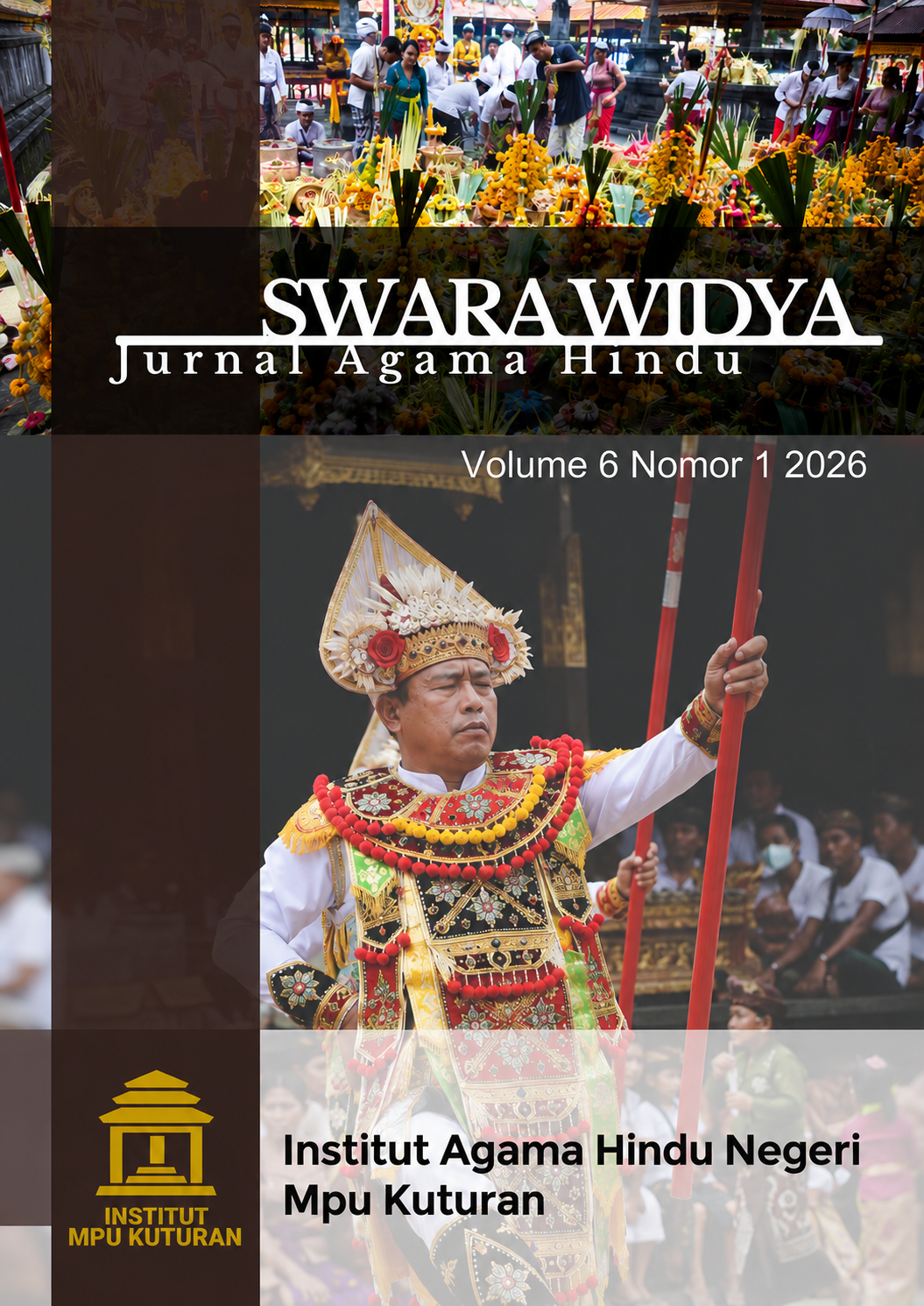
KAJIAN FILOSOFI TRADISI DARATAN DI DESA SENGKIDU KECAMATAN MANGGIS KABUPATEN KARANGASEM
Keywords:
Daratan (Narat) Tradition; philosophy; Balinese culture; religiosity; Tri Hita KaranaAbstract
The Daratan (Narat) Tradition is one of the sacred cultural heritages of the Balinese Hindu community that continues to be preserved in Sengkidu Village, Manggis District, Karangasem Regency. This tradition functions not only as an integral part of religious ceremonies but also embodies philosophical values that reflect the harmonious relationship between humans, God, fellow human beings, and nature. This study aims to analyze the implementation process of the Daratan (Narat) Tradition, explore its philosophical meanings, and examine its implications for the religious, social, and cultural life of the local community. This research employed a descriptive qualitative approach with a phenomenological perspective. Data were collected through observation, in-depth interviews, and documentation involving temple priests, customary leaders, and community members actively participating in the tradition. Data analysis consisted of data reduction, data presentation, and conclusion drawing. The findings reveal that the Daratan (Narat) Tradition serves as a medium for preserving religious values inherited across generations. Philosophically, the tradition reflects the harmonious relationship between humans and God, among human beings, and with the natural environment, as embodied in the concept of Tri Hita Karana. Furthermore, the tradition strengthens social solidarity, preserves local cultural identity, and functions as a means of transmitting spiritual values to younger generations. Therefore, the Daratan (Narat) Tradition plays a strategic role in sustaining the continuity of Balinese Hindu culture and religious life amid contemporary social changes.